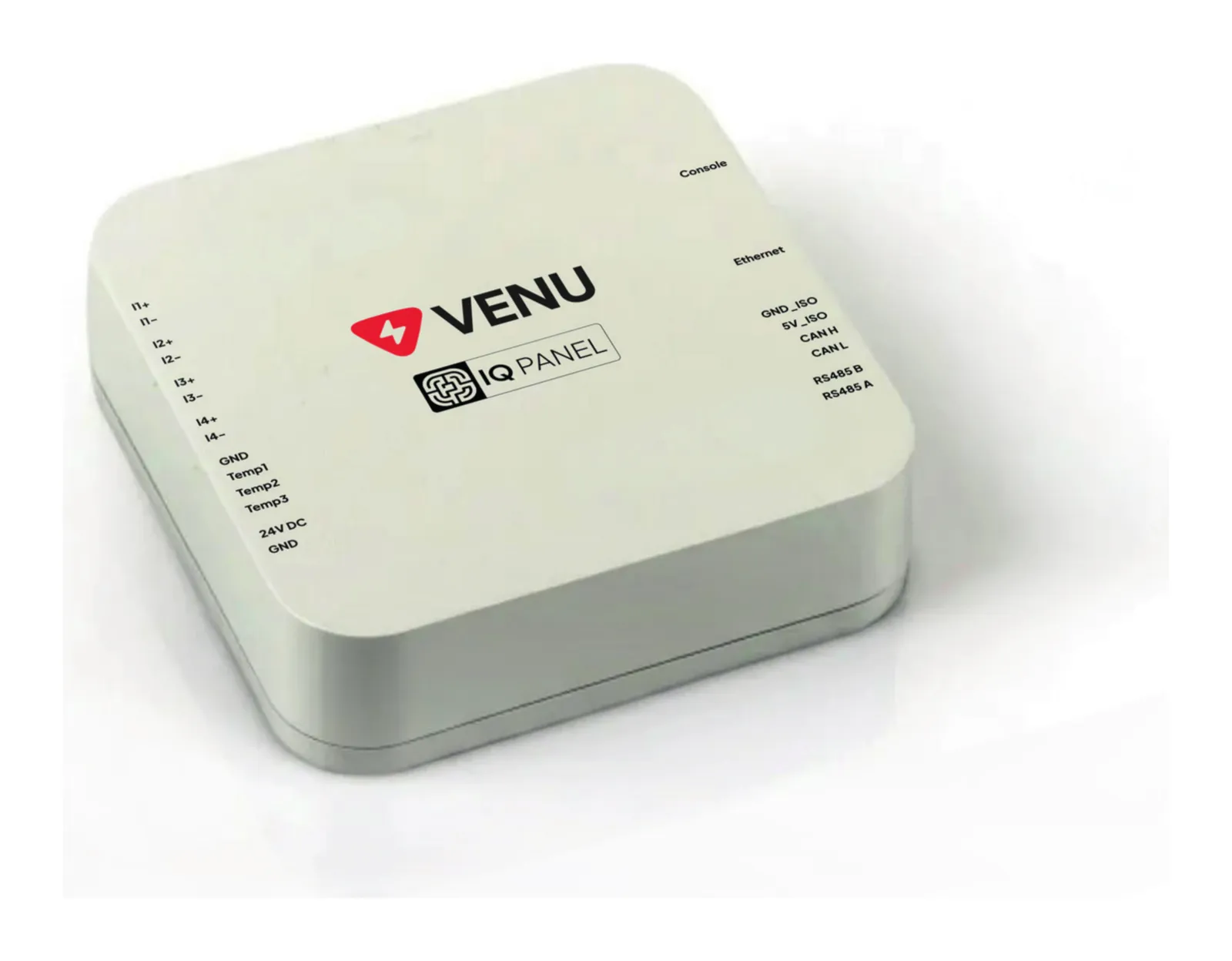
Product code: CTX-IQ-100
IQ Panel
The edge controller that hosts the Cortex platform's embedded AI inference engine.
Collects and time-synchronises data from every Sense probe on the field bus and processes it on an embedded AI engine. The output is a continuously updated predictive-maintenance risk score for each monitored asset.
- Modbus TCP
- Modbus RTU
- MQTT/TLS
The IQ Panel collects and time-synchronises data from every Sense probe on the field bus and processes it on an embedded AI engine. The output is a continuously updated predictive-maintenance risk score for each monitored asset.
Where inference runs
Inference runs entirely locally. The frequency-analysis models — Isolation iForest, ANN and LSTM based — execute on the Arm Cortex-M33 core and need no cloud connection; a communication outage does not stop alarm generation. This architecture meets the requirement for a network-independent safety function in critical infrastructure.
Per-device modelling
The system maintains a separate behavioural model for every panel and every device it monitors. The reference signature learned during commissioning captures the asset’s load profile, thermal behaviour and environmental conditions. The risk score is computed as a deviation from that signature. As a result, the same software runs on panels with very different load characteristics without manual threshold definition, and equipment operating in a steady state does not produce a high score.
Integration
Results are exported to SCADA, MES and ERP systems over Modbus TCP, Modbus RTU and MQTT/TLS. No middleware layer is required. Dry-contact relay outputs can drive contactors, warning sirens and line-disconnect circuits directly, so the system is not limited to a reporting role.
Key features
- Edge AI inference — risk scoring runs independently of any cloud connection, so alarm latency does not depend on network conditions.
- Per-device learning — each panel is evaluated against its own reference signature, with no threshold tuning during commissioning.
- Time-synchronised acquisition — events across different probes are correlated on a single time axis.
- Daisy-chained field bus — a single cable run serves up to 32 nodes; no star topology or dedicated run per probe.
- Native protocol support — Modbus TCP/RTU and MQTT/TLS for OT/IT integration without middleware.
- Field updates — firmware and ONNX model files are updated over the network, with no need to remove the device.
Technical specifications
Processor and software
| Product code | CTX-IQ-100 |
|---|---|
| Processor | 32-bit Arm Cortex-M33, STM32H5 series |
| Real-time operating system | ThreadX / NetX Duo |
| Inference engine | ANN and LSTM based embedded models, ONNX model deployment |
Field bus and communication
| Field bus | Galvanically isolated CAN-FD, 5 Mbit/s, daisy chain |
|---|---|
| Bus capacity | Up to 32 nodes |
| Wired communication | 10/100 Mbit Ethernet, RS485 |
| Protocols | Modbus TCP, Modbus RTU, MQTT/TLS |
| Wireless communication | Pluggable WiFi / cellular / LoRaWAN module |
Outputs and data
| Relay outputs | Dry contact (quantity to be confirmed) |
|---|---|
| Data buffering | Internal flash ring buffer; lossless across connection outages |
Electrical and mechanical
| Power supply | 9-36 VDC (24 VDC nominal) |
|---|---|
| Operating temperature | −20 °C … +60 °C |
| Enclosure | ABS UL94-V0, 100 × 100 × 27.5 mm |
| Mounting | Surface or DIN rail |
Frequently asked questions
Does the IQ Panel need an internet connection to raise an alarm?
No. Inference runs entirely locally on the Arm Cortex-M33 core. A communication outage does not stop alarm generation; the cloud connection belongs to the reporting and fleet-management layer. This architecture meets the requirement for a network-independent safety function in critical infrastructure.
Do thresholds have to be configured for each panel individually?
No. The IQ Panel learns a reference signature for every monitored asset during the commissioning window. Because the risk score is computed as a deviation from that signature, the same software runs on panels with very different load characteristics without manual threshold definition, and equipment operating in a steady state does not produce a high score.
How does it connect to our existing SCADA system?
Results are exported to SCADA, MES and ERP systems over Modbus TCP, Modbus RTU and MQTT/TLS, with no middleware layer required. Every probe type reports into a single consistent register model, so there is no per-sensor driver development.
How many sensors can be connected to one IQ Panel?
The field bus uses a daisy-chain topology and supports up to 32 nodes. A single cable run serves every probe in a panel or along a machine line — no star topology and no dedicated run per probe.