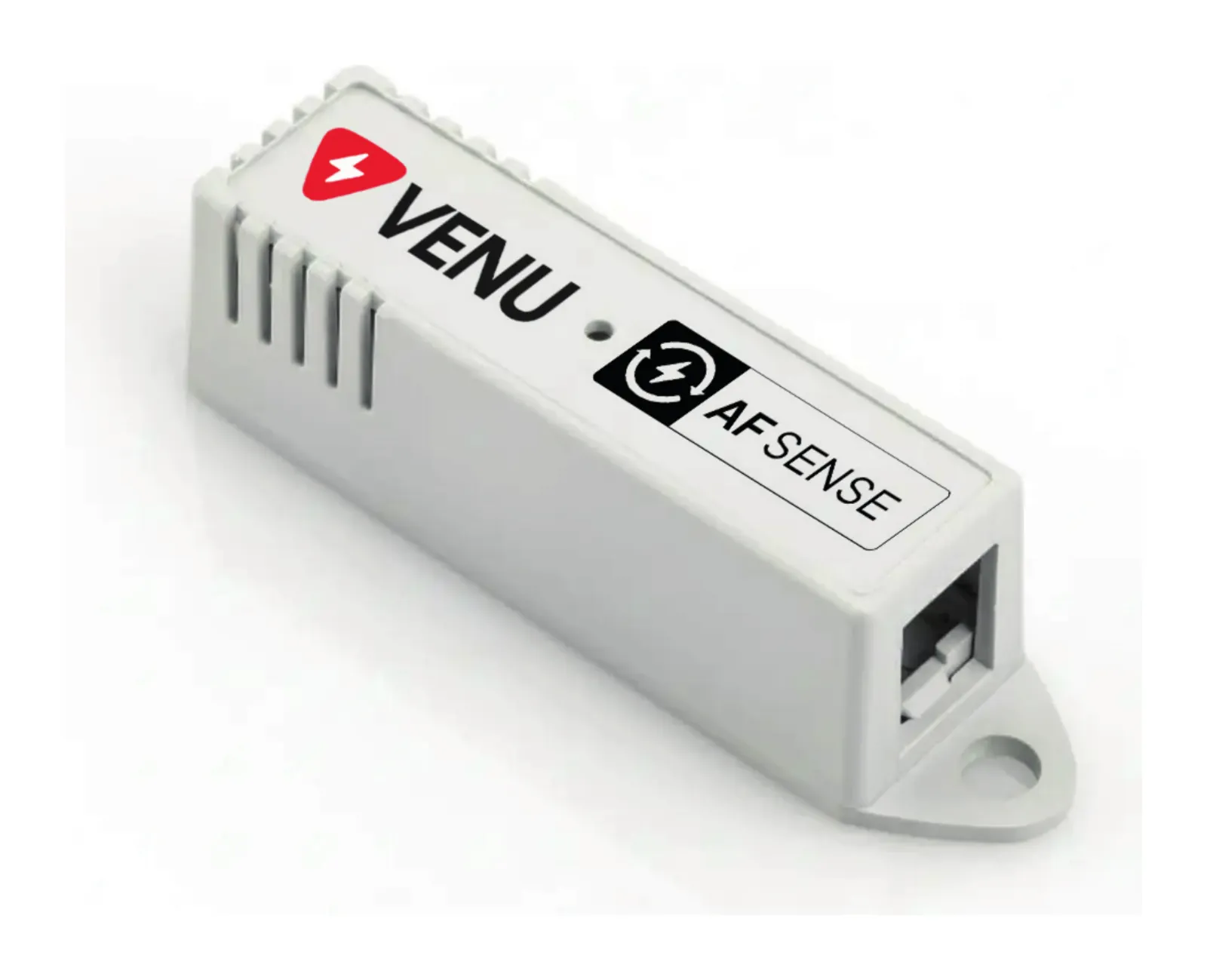
Product code: ARF-005
ArcFire Sense
A multi-channel gas, thermal and electrical signature probe for electrical panels.
Measures the leading indicators of fire and arc-fault risk inside low-voltage switchboards, switchgear cells, transformer rooms and motor control cabinets — warning from the outgassing signature that precedes any smoke or flame.
- IP40
- CAN-FD
- Modbus TCP
ArcFire Sense measures the leading indicators of fire and arc-fault risk inside low-voltage switchboards, switchgear cells, transformer rooms and motor control cabinets.
Why a gas signature?
Thermal events inside a panel do not appear suddenly. Loosening terminals, rising contact resistance and insulation breakdown produce a measurable outgassing signature and an accompanying thermal gradient. The probe evaluates that signature together with multi-channel gas measurement, ambient and surface temperature, relative humidity and load current data. The particulate a smoke detector responds to appears far later in this chain.
Operating principle
Every measurement channel passes through a Kalman filter on the probe. Switching transients, door-opening events and ventilation cycles do not reach the risk function. Filtered data is transmitted to the IQ Panel over a galvanically isolated CAN-FD bus.
Risk scoring is based on a physics-informed model: thermal rise is evaluated together with load current, so an expected temperature rise under increasing load is not classified as a fault. This gives a markedly lower false-alarm rate than purely statistical anomaly detection.
Commissioning
The probe learns the steady-state behaviour of the panel it is mounted in during commissioning. Because each panel is modelled separately, sites with different load profiles do not require thresholds to be defined one by one.
Key features
- Early warning from the outgassing signature that precedes smoke and flame.
- Sensor fusion of gas, thermal and electrical channels into a single risk function.
- Per-channel Kalman filtering suppresses switching noise and environmental events.
- Installed without de-energising the panel or mechanically modifying its enclosure; commissioning does not halt production.
- Daisy-chain topology — several probes per panel on a single field bus.
- Machine learning matches thermal load against gas, particulate, temperature and current signatures to classify electrical overload.
Technical specifications
Measurement channels
| Product code | ARF-005 |
|---|---|
| Gas / measurement channels | VOC / gas resistance, TVOC, eCO₂, CO, H₂, NO₂ |
| Detected compounds | TVOC, ozone, CO, CO₂, hydrogen, NO₂, benzene, acetone, ethanol, SO₂, H₂S, CS₂, ammonia, methane, propane, butane, acetylene |
| CO measurement range | 1 – 1,000 ppm |
| NO₂ measurement range | 0.05 – 10 ppm |
| Surface temperature | NTC probe, −40 °C … +125 °C |
Accuracy
| Temperature accuracy | ±0.2 °C |
|---|---|
| Relative humidity accuracy | ±2 %RH |
| Pressure accuracy | ±0.6 hPa |
Signal processing and communication
| Signal processing | FFT, EKF, peak, kurtosis, envelope analysis |
|---|---|
| Communication | Galvanically isolated CAN-FD 5 Mbit/s; Modbus TCP in standalone use |
Electrical and mechanical
| Power supply | 9-36 VDC over the field bus |
|---|---|
| Operating temperature | −20 °C … +60 °C (electronics) |
| Ingress protection | IP40 — in-panel and indoor applications |
| Enclosure | ABS UL94-HB, 72 × 19 × 20 mm |
| Mounting | Magnetic or screw fixing; suitable for live installation |
Frequently asked questions
How is ArcFire Sense different from a conventional smoke detector?
A smoke detector responds to particulate that appears once a fire has already started. ArcFire Sense targets the stage before any smoke or flame: loosening terminals, rising contact resistance and insulation breakdown produce a measurable outgassing signature and an accompanying thermal gradient. The probe evaluates that signature together with multi-channel gas measurement, ambient and surface temperature, relative humidity and load current.
How is the false-alarm rate kept low?
Every measurement channel passes through a Kalman filter on the probe, so switching transients, door-opening events and ventilation cycles do not reach the risk function. Risk scoring is also based on a physics-informed model: thermal rise is evaluated together with load current, so an expected temperature rise under increasing load is not classified as a fault. This gives a markedly lower false-alarm rate than purely statistical anomaly detection.
Does the panel have to be de-energised for installation?
No. The probe is installed without cutting power and without mechanical modification to the panel enclosure; the magnetic and screw mounting options are suitable for live installation. Commissioning does not halt production.
Can more than one probe be connected to a single panel?
Yes. The field bus uses a daisy-chain topology, so several probes per panel run on one field bus and no dedicated cable run per probe is needed.