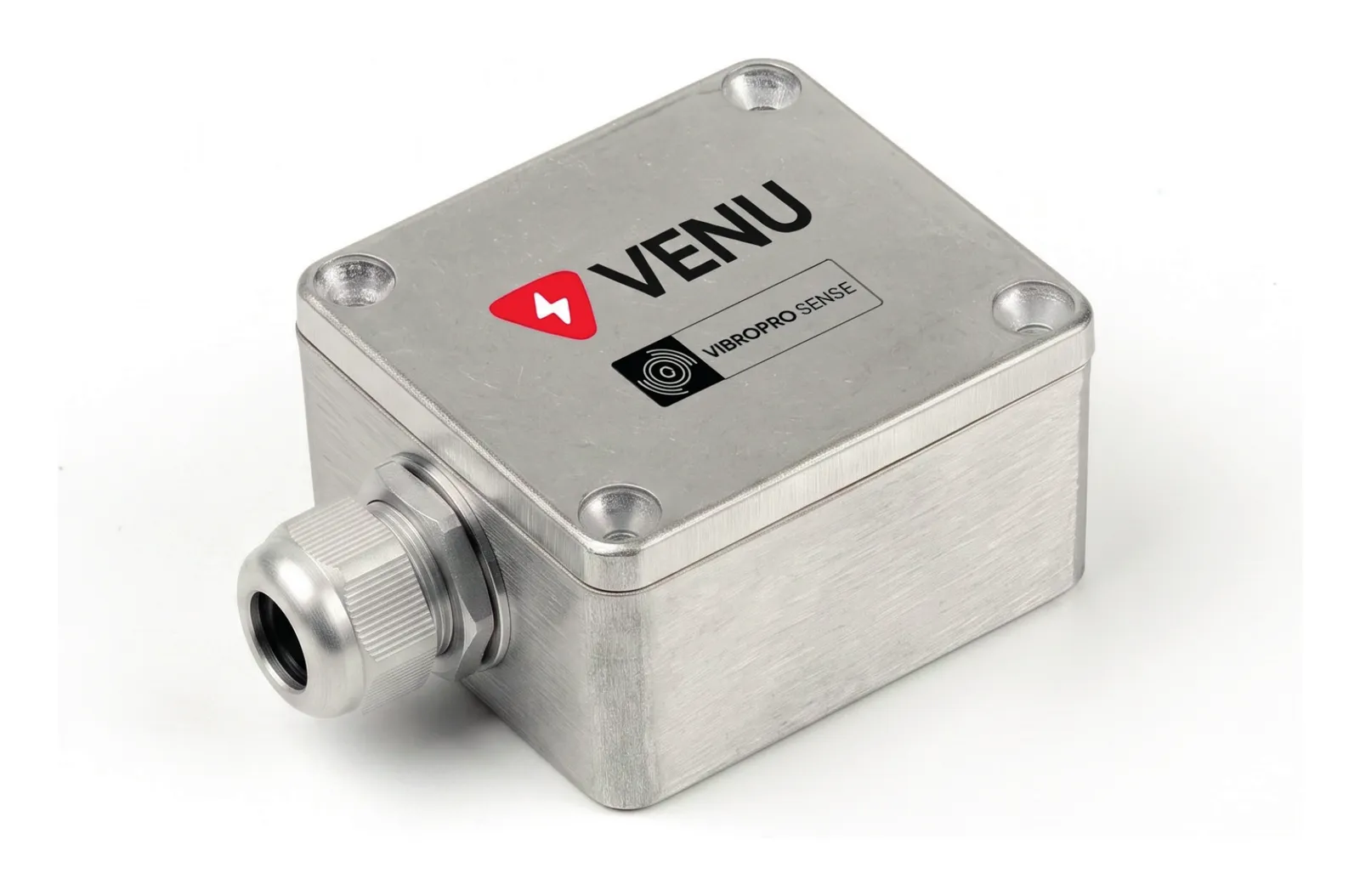
Product code: VIB-201
VibroPro Sense
A wide-bandwidth spectral analysis probe for high-speed rotating equipment.
Designed for applications where the diagnostic information sits above the standard industrial accelerometer band — CNC spindles, high-speed bearings, gearboxes and turbomachinery. Provides DC – 6.3 kHz flat response and a 4096-point FFT per second.
- IP65
- CAN-FD
VibroPro Sense is designed for applications where the diagnostic information sits above the standard industrial accelerometer band — CNC spindles, high-speed bearings, gearboxes and turbomachinery.
Early-stage bearing defects, gear mesh harmonics and tool wear signatures typically appear in the upper kilohertz range. A standard probe with 1.6 kHz bandwidth cannot resolve these components.
Operating principle
The probe samples three axes at a raw rate of 26.667 kHz per axis; the analysis chain decimates this to a gap-free 4096 Hz. The raw waveform never reaches the bus — the spectral transform and envelope analysis are performed on the device, producing one complete spectrum per second. This keeps bus bandwidth constant regardless of machine speed.
Data acquisition uses ping-pong DMA: while one buffer is being processed the other is filling, so there is no gap in the sample stream. CAN-FD frames pass through an Extended Kalman Filter (EKF) before transmission; drive and inverter switching noise is suppressed while the spectral peaks that carry diagnostic information are preserved.
Per-device modelling
Each probe learns the reference signature of the equipment it is mounted on during commissioning. Because the health score is computed as a deviation from that signature, machines with different speed and load characteristics do not require individual threshold definitions.
Key features
- The highest FFT resolution and bandwidth in its class.
- On-device spectral analysis — bus load stays constant regardless of machine speed.
- Separates imbalance, misalignment, mechanical looseness and bearing defects from one another.
- EKF filtering suppresses inverter and drive switching noise.
- Ping-pong DMA gives gap-free sampling; no event is lost between sample windows.
- Cast aluminium body couples directly to the surface; no intermediate adapter block required.
- IP65 rated — suitable for washdown lines, dusty environments and outdoor installations.
Technical specifications
Sensing and measurement
| Product code | VIB-201 |
|---|---|
| Sensing element | 3-axis wide-bandwidth MEMS accelerometer |
| Measurement range | ±2 / ±4 / ±8 / ±16 g, selectable |
| Raw sampling rate | 26.667 kHz per axis |
| Sampling period | 37.5 µs |
| Analysis sampling rate | 4096 Hz, gap-free (decimated) |
| Surface temperature | NTC probe, −40 °C … +125 °C |
Spectral analysis
| Frequency range | DC – 6.3 kHz flat response |
|---|---|
| Spectral output | 4096-point FFT per axis per second |
| Data acquisition | Ping-pong DMA, gap-free sampling |
| Noise density | 75 µg/√Hz |
| Signal processing | 3-axis parallel FFT, EKF, peak, kurtosis, envelope analysis |
Electrical and mechanical
| Communication | Galvanically isolated CAN-FD 5 Mbit/s, daisy chain |
|---|---|
| Power supply | Isolated 5 VDC from the IQ Panel |
| Operating temperature | −40 °C … +85 °C |
| Ingress protection | IP65 |
| Enclosure | Cast aluminium, 64 × 58 × 35 mm |
| Mounting | Stud or adhesive pad |
Frequently asked questions
Why is a standard vibration probe inadequate for CNC spindles?
Early-stage bearing defects, gear mesh harmonics and tool wear signatures typically appear in the upper kilohertz range. A standard probe with 1.6 kHz bandwidth cannot resolve these components. VibroPro Sense covers that band with DC – 6.3 kHz flat response.
When should I choose VibroPro Sense over Vibro Sense?
Whenever the diagnostic information sits above 1.6 kHz: CNC spindles, high-speed bearings, gearboxes, turbomachinery and robotic joints are typical applications. For standard-speed electric motors, pumps, fans and gearboxes, Vibro Sense (VIB-101) is sufficient.
What does gap-free sampling mean?
Data acquisition uses ping-pong DMA: while one buffer is being processed the other is filling, so there is no gap in the sample stream. A short, transient event cannot fall between sample windows and be missed.
Is raw data sent over the network?
No. The raw waveform never reaches the bus — the spectral transform and envelope analysis are performed on the device, producing one complete spectrum per second. This keeps bus bandwidth constant regardless of machine speed.