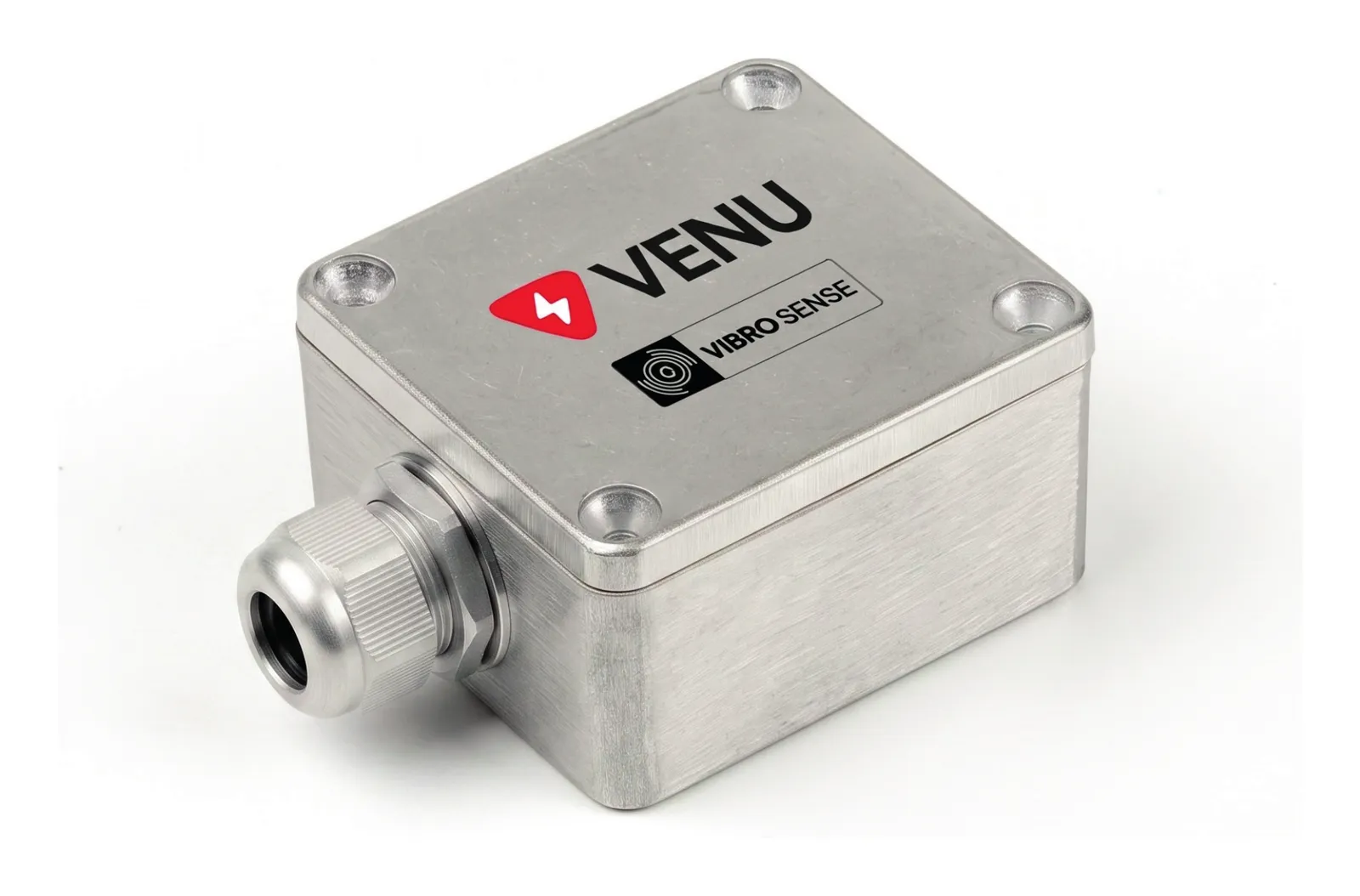
Product code: VIB-101
Vibro Sense
A three-axis vibration and surface temperature condition-monitoring probe for rotating equipment.
Detects the early indicators of mechanical degradation in electric motors, pumps, fans, gearboxes and compressors through spectral analysis. Bearing defects, imbalance and misalignment become measurable long before the equipment shows any audible sign.
- IP65
- CAN-FD
Vibro Sense detects the early indicators of mechanical degradation in electric motors, pumps, fans, gearboxes and compressors through spectral analysis.
Bearing defects, imbalance, misalignment and mechanical looseness produce characteristic frequency components that separate cleanly in the vibration spectrum. These components become measurable long before the equipment gives any audible or tactile sign.
Operating principle
The probe samples three axes at 4096 Hz per axis. The raw waveform never reaches the bus — the spectral transform and envelope analysis are performed on the device, producing one complete spectrum per second. This keeps bus bandwidth constant regardless of machine speed.
CAN-FD frames pass through an Extended Kalman Filter (EKF) before transmission. Drive and inverter switching noise is suppressed while the spectral peaks that carry diagnostic information are preserved.
Per-device modelling
Each probe learns the reference signature of the equipment it is mounted on during commissioning. Because the health score is computed as a deviation from that signature, machines with different speed and load characteristics do not require individual threshold definitions.
Key features
- On-device spectral analysis — bus load stays constant regardless of machine speed.
- Separates imbalance, misalignment, mechanical looseness and bearing defects from one another.
- EKF filtering suppresses inverter and drive switching noise.
- Time-correlated measurement of vibration, magnetic field and surface temperature from a single point.
- Purpose-designed aluminium housing that transfers vibration to the sensor with minimal noise.
- Cast aluminium body couples directly to the surface; no intermediate adapter block required.
- IP65 rated — suitable for washdown lines, dusty environments and outdoor installations.
Technical specifications
Sensing and measurement
| Product code | VIB-101 |
|---|---|
| Sensing element | 6-axis MEMS IMU (3-axis accelerometer + gyroscope) |
| Measurement range | ±2 / ±4 / ±8 / ±16 g, selectable |
| Sampling rate | 4096 Hz per axis |
| Sampling period | 244 µs |
| Surface temperature | NTC probe, −40 °C … +125 °C |
Spectral analysis
| Spectral output | 2048-point FFT per axis per second |
|---|---|
| Frequency resolution | 6.5 Hz |
| Frequency range | DC – 1.6 kHz |
| Noise density | 80 µg/√Hz |
| Signal processing | FFT, EKF, peak, kurtosis, envelope analysis |
Electrical and mechanical
| Communication | Galvanically isolated CAN-FD 5 Mbit/s, daisy chain |
|---|---|
| Power supply | Isolated 5 VDC from the IQ Panel |
| Operating temperature | −40 °C … +85 °C |
| Ingress protection | IP65 |
| Enclosure | Cast aluminium, 64 × 58 × 35 mm |
| Mounting | Stud, adhesive pad or magnetic base |
Frequently asked questions
What is the difference between Vibro Sense and VibroPro Sense?
Vibro Sense (VIB-101) covers the standard industrial band: 4096 Hz sampling per axis, a 2048-point FFT per second and a DC – 1.6 kHz frequency range, designed for electric motors, pumps, fans and gearboxes. VibroPro Sense (VIB-201) provides DC – 6.3 kHz flat response and a 4096-point FFT per second, for applications such as CNC spindles, high-speed bearings and turbomachinery where the diagnostic information sits above the standard band.
Is raw vibration data sent over the network?
No. The raw waveform never reaches the bus — the spectral transform and envelope analysis are performed on the device, producing one complete spectrum per second. This keeps bus bandwidth constant regardless of machine speed.
Is switching noise a problem on inverter-driven motors?
CAN-FD frames pass through an Extended Kalman Filter (EKF) before transmission. Drive and inverter switching noise is suppressed while the spectral peaks that carry diagnostic information are preserved.
Do machines running at different speeds and loads need separate thresholds?
No. Each probe learns the reference signature of the equipment it is mounted on during commissioning. Because the health score is computed as a deviation from that signature, machines with different speed and load characteristics do not require individual threshold definitions.