Rotating machinery condition monitoring
Measure a bearing defect before it changes the sound of the machine.
By the time a bearing defect or spindle wear becomes audible, the failure has already progressed. In the vibration spectrum the same defect shows up far earlier as characteristic frequency components — provided something is watching continuously.
Contact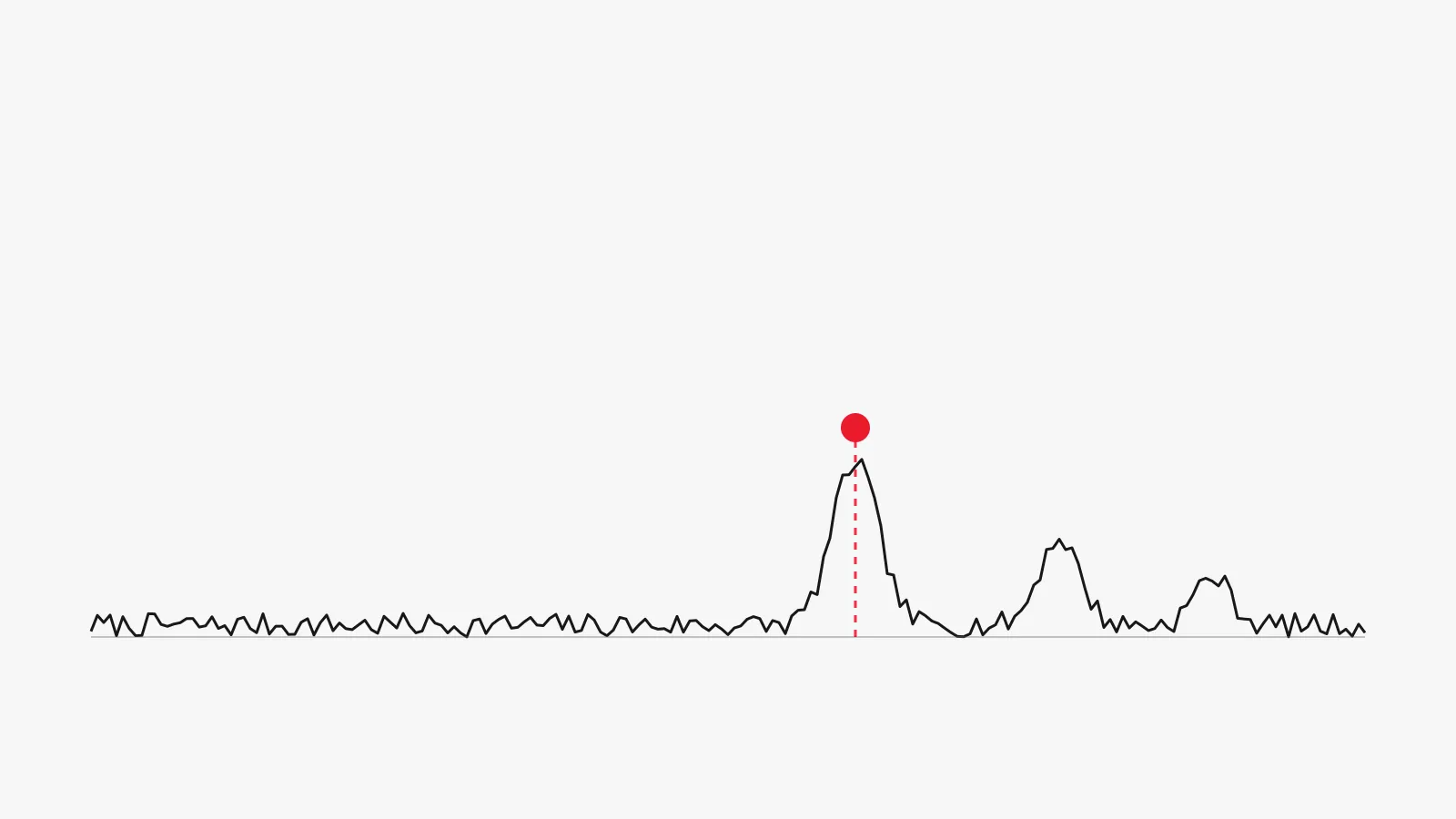
The failure appears in the spectrum first
Bearing defects, imbalance, misalignment and mechanical looseness produce characteristic frequency components that separate cleanly in the vibration spectrum. These components become measurable long before the equipment gives any audible or tactile sign.
The problem is not that this physics is unknown — it is that periodic handheld measurements cannot show what happened during the weeks between two readings.
Why on-device analysis matters
Vibro Sense and VibroPro Sense never put the raw waveform on the bus. The spectral transform and envelope analysis are performed on the probe itself, producing one complete spectrum per second. That has two practical consequences.
First, bus bandwidth stays constant regardless of machine speed — a 32-node field bus does not saturate when the machines speed up. Second, no data needs to reach the cloud for a diagnostic decision; the IQ Panel produces the health score locally.
The special case of CNC spindles
Early-stage bearing defects, gear mesh harmonics and tool wear signatures typically appear in the upper kilohertz range. A standard probe with 1.6 kHz bandwidth cannot resolve these components. VibroPro Sense covers that band with DC – 6.3 kHz flat response and a 4096-point FFT per second; ping-pong DMA leaves no gap in the sample stream, so short transient events are not lost.
Recommended product combination
- VIB-101Vibro SenseA three-axis vibration and surface temperature condition-monitoring probe for rotating equipment.
- VIB-201VibroPro SenseA wide-bandwidth spectral analysis probe for high-speed rotating equipment.
- CTX-IQ-100IQ PanelThe edge controller that hosts the Cortex platform's embedded AI inference engine.
Frequently asked questions
Which vibration probe should I choose?
For standard-speed electric motors, pumps, fans and gearboxes, Vibro Sense (VIB-101) is sufficient; it covers the DC – 1.6 kHz band. Where the diagnostic information sits above 1.6 kHz — CNC spindles, high-speed bearings, gearboxes, turbomachinery and robotic joints — VibroPro Sense (VIB-201) is required.
Do machines running at different speeds need individual tuning?
No. Each probe learns the reference signature of the equipment it is mounted on during commissioning, and the health score is computed as a deviation from that signature. Machines with different speed and load characteristics do not get thresholds defined one by one.
Does switching noise corrupt measurements on inverter-driven motors?
CAN-FD frames pass through an Extended Kalman Filter (EKF) before transmission. Drive and inverter switching noise is suppressed while the spectral peaks that carry diagnostic information are preserved.
How many machines can one IQ Panel monitor?
The field bus supports a daisy chain of up to 32 nodes. A single cable run serves every probe along a machine line; no dedicated run per probe is needed.