Bearing failure in a CNC spindle — when does the spectrum start talking?
A bearing defect in a CNC spindle appears in the vibration spectrum weeks before it marks the workpiece. This piece walks through where that signature forms, why a standard vibration probe cannot resolve it, and how VibroPro Sense catches it.
Venu ElectronicsPublished:
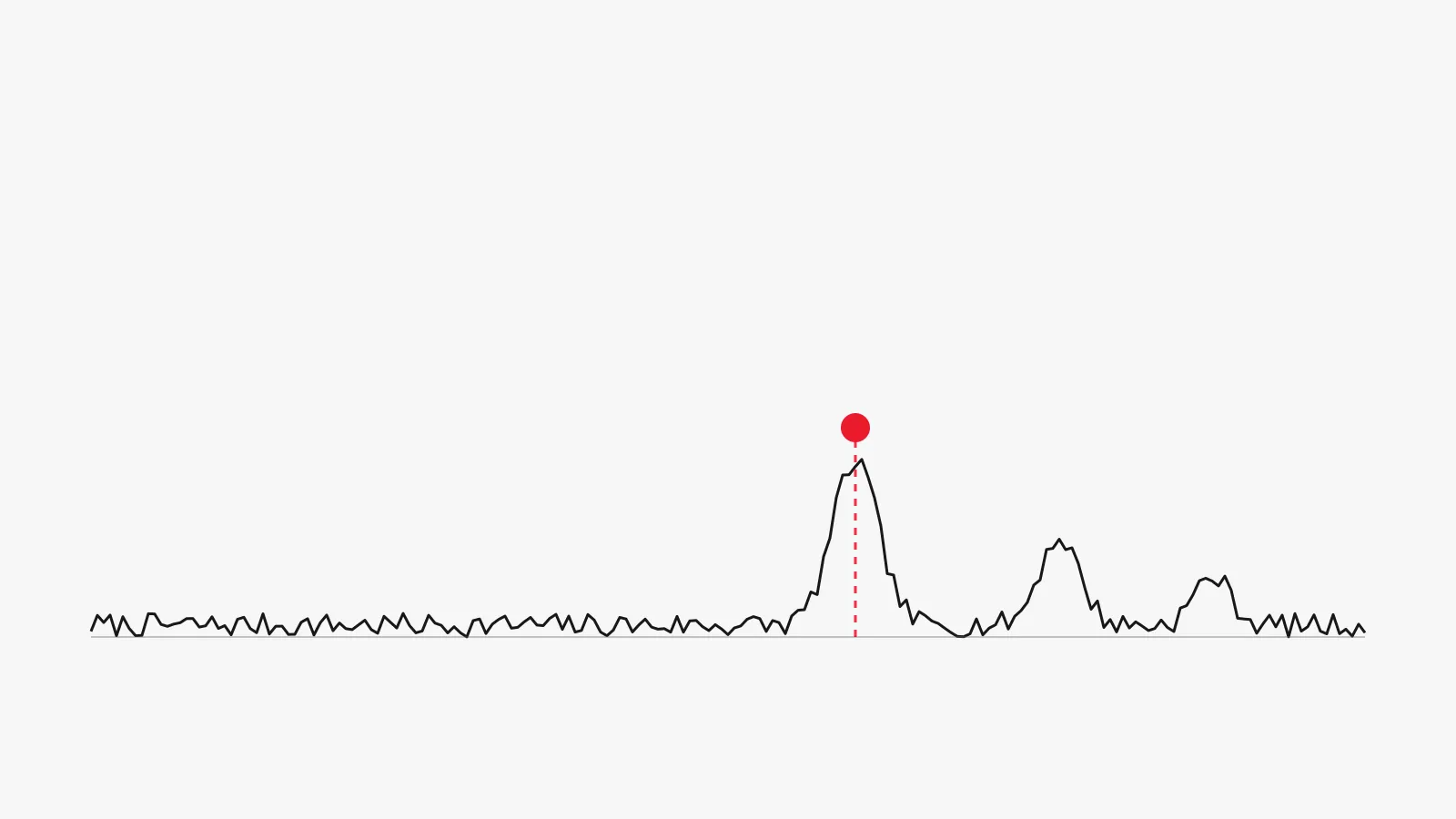
There are usually two ways people find out a CNC spindle is degrading: surface quality on the workpiece drops, or the operator notices the sound has changed. In both cases the failure has already reached a certain maturity.
The same defect, however, exists as a measurable signal far earlier.
Where the defect signature forms
Micro-pitting (spalling) on a bearing’s inner race, outer race or rolling elements produces a brief impulse at every contact. Those impulses repeat at specific frequencies determined by the bearing geometry and shaft speed — ball pass frequency outer (BPFO), ball pass frequency inner (BPFI), ball spin frequency (BSF) and fundamental train frequency (FTF).
Here is the critical point: those impulses excite the structure’s natural resonances, and the energy appears as envelope modulation in a band well above the fundamental defect frequency. While the defect is early-stage, the overall vibration level (RMS) barely moves — what changes is this fine structure in the upper part of the spectrum.
Why the 1.6 kHz limit is a problem
On a spindle turning at 24,000 rpm the fundamental rotational frequency is 400 Hz. Bearing defect frequencies are multiples of it, and the resonance band that envelope analysis examines typically sits at several kilohertz.
DC – 1.6 kHz, the common band of standard industrial accelerometers, does not cover the region where the diagnostic information lives in this application. The probe works correctly, collects data, may even show a trend — but the signature you are looking for is outside the measurement band.
This is why VibroPro Sense (VIB-201) is designed with DC – 6.3 kHz flat response. Raw sampling is 26.667 kHz per axis and the analysis chain decimates that to a gap-free 4096 Hz, producing a 4096-point FFT per axis per second.
Why gap-free sampling matters
Bearing impulses are brief. If there is a gap in the sample stream, an entire group of impulses can be missed. VibroPro Sense uses ping-pong DMA for acquisition: while one buffer is being processed the other is filling, so there is no gap in the stream.
Deviation, not thresholds
On a variable-speed machine, an alarm rule watching a fixed frequency band cannot work reliably — as the speed changes, the defect frequencies move with it.
Cortex handles the problem differently. Each probe learns the reference signature of the equipment it is mounted on during commissioning, and the health score is computed as a deviation from that signature. As a result, machines with different speed and load characteristics do not need thresholds defined one by one, and a machine running in its normal regime does not produce a high score.
What changes in the field
The practical value of early warning is that a bearing replacement can be moved from an unplanned stop into a planned maintenance window. A scheduled spindle bearing change is a job measured in hours; the same bearing seizing in service can damage the shaft, the housing and sometimes the machine slide.
Frequently asked questions
Why do bearing fault frequencies shift with machine speed?
Bearing defect frequencies (BPFO, BPFI, BSF, FTF) arise as direct multiples of shaft speed, so they move as the speed changes. An alarm rule watching a fixed frequency band therefore cannot work reliably on a variable-speed machine. Cortex instead measures deviation from the equipment's own reference signature.
Why is 1.6 kHz bandwidth inadequate for CNC spindles?
Early-stage bearing defects, gear mesh harmonics and tool wear signatures typically appear in the upper kilohertz range. On a spindle running at 24,000 rpm the fundamental rotational frequency is already 400 Hz; defect harmonics and envelope components climb above 1.6 kHz quickly.
Wouldn't recording raw data for later analysis be better?
Continuous raw recording demands more bandwidth than a 32-node field bus can carry and creates storage cost. VibroPro Sense instead performs the spectral transform on the probe and produces one complete spectrum per second — preserving the diagnostic information while keeping bus load constant.
- CNC
- bearings
- spectral analysis
- spindle
Related products
- VIB-201VibroPro SenseA wide-bandwidth spectral analysis probe for high-speed rotating equipment.
- VIB-101Vibro SenseA three-axis vibration and surface temperature condition-monitoring probe for rotating equipment.
- CTX-IQ-100IQ PanelThe edge controller that hosts the Cortex platform's embedded AI inference engine.