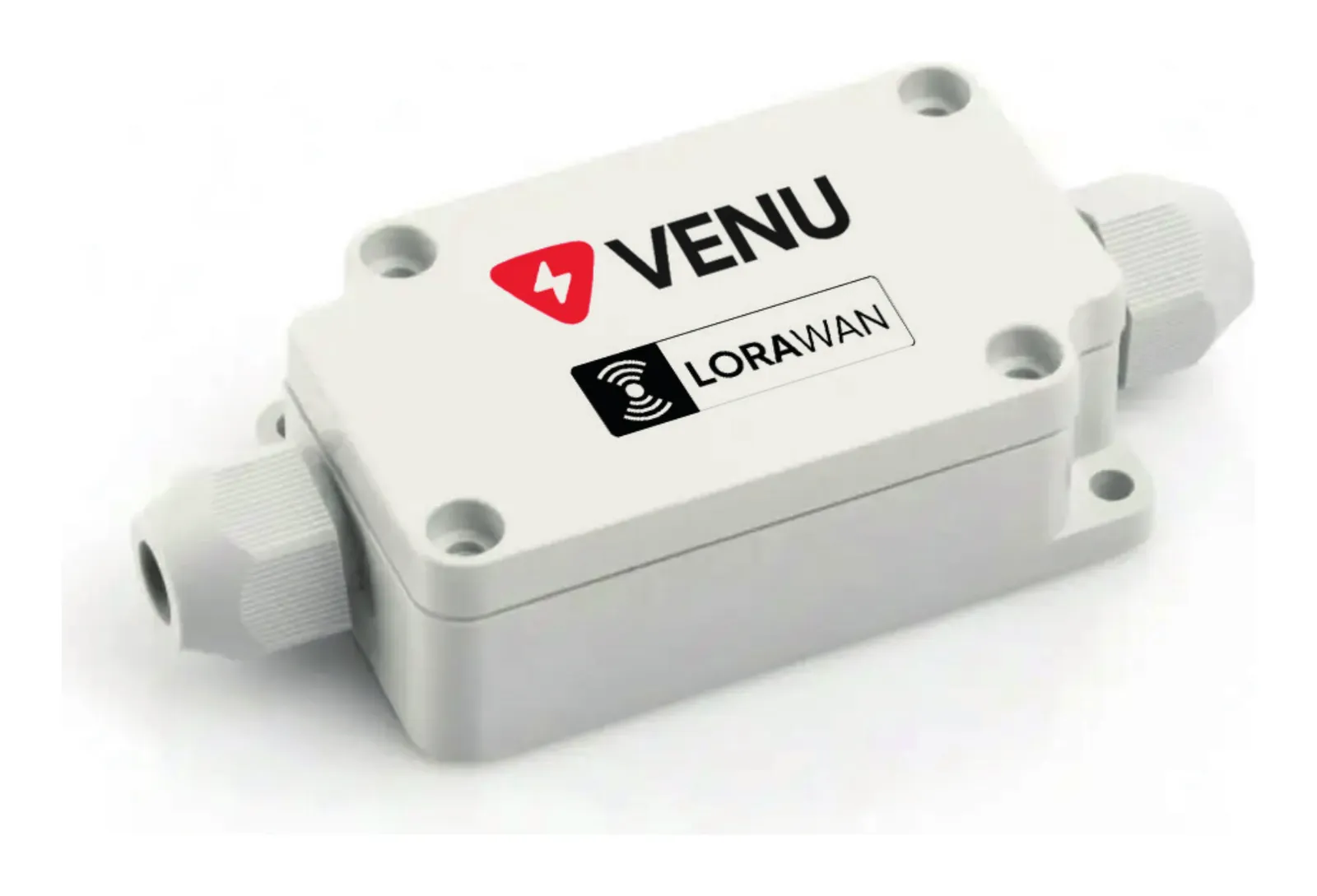
Product code: CM-L300
LoRaWAN Module
A long-range, low-power communication module for wide-area field topologies.
Designed for topologies where many monitoring points are spread across a wide geography. A single gateway covers a kilometre-scale area, and as the number of points grows, the communication cost per connected node falls markedly compared with a cellular subscription model.
- IP67
- LoRaWAN 1.0.4
The LoRaWAN Module is designed for topologies where many monitoring points are spread across a wide geography. Electricity distribution networks, ports, large industrial campuses and municipal infrastructure are typical applications.
A single gateway covers a kilometre-scale area. As the number of points grows, the communication cost per connected node falls markedly compared with a cellular subscription model.
Payload model
Because of LoRaWAN duty-cycle limits, the module transmits derived data rather than raw telemetry: risk score, alarm state and periodic summary values. Applications that require continuous full-resolution telemetry should use the WiFi or cellular module.
Regional variants are available for the EU868, US915 and AS923 frequency plans; with OTAA and ABP activation the module integrates with existing private or public LoRaWAN networks.
Key features
- Kilometre-scale coverage from a single gateway; lower communication cost per node.
- Up to 10 km line-of-sight range; −137 dBm receiver sensitivity.
- Transmits derived data (risk score and alarm state) to stay within duty-cycle limits.
- Class C support for installations that require downlink commands.
- Integrates with existing private or public LoRaWAN networks; no dedicated infrastructure required.
- Shares the expansion slot and enclosure with the WiFi and cellular modules.
Technical specifications
Radio and range
| Product code | CM-L300 |
|---|---|
| Protocol | LoRaWAN 1.0.4, Class A / Class C |
| Frequency plan | EU868 / US915 / AS923 regional variants |
| Transmit power | Up to +22 dBm |
| Receiver sensitivity | Down to −137 dBm |
| Range | Up to 10 km line of sight; 1-2 km urban |
Activation and data
| Activation | OTAA or ABP |
|---|---|
| Transmitted data | Risk score, alarm state, periodic summary values |
| Antenna | External SMA connector |
| Interface | IQ Panel expansion slot |
Electrical and mechanical
| Power supply | 9-36 VDC (24 VDC nominal) |
|---|---|
| Operating temperature | −20 °C … +60 °C |
| Ingress protection | IP67 |
| Enclosure | ABS, 80 × 50 × 25 mm, with glands |
Frequently asked questions
Does the LoRaWAN module transmit raw telemetry?
No. Because of LoRaWAN duty-cycle limits, the module transmits derived data rather than raw telemetry: risk score, alarm state and periodic summary values. Applications that require continuous full-resolution telemetry should use the WiFi (CM-W100) or cellular (CM-G200) module.
Do we have to build our own LoRaWAN infrastructure?
No. With OTAA and ABP activation it integrates with existing private or public LoRaWAN networks; no dedicated infrastructure is required. Regional variants are available for the EU868, US915 and AS923 frequency plans.
When should I choose the LoRaWAN module?
For topologies with many scattered nodes spread across a wide geography: electricity distribution networks, ports, large industrial campuses and municipal infrastructure. A single gateway provides kilometre-scale coverage, and where a gateway already exists there is no additional operating cost.
Can commands be sent to the device remotely?
Class C is supported for installations that require downlink commands.